Hyperbaric oxygen therapy (breathing oxygen in a pressurized chamber) has moved from hospitals and dive medicine into the wellness mainstream. A July 2026 survey of 26 listings put new soft-shell home chambers at a median of about $13,500.
Here is what these chambers are, what the two types differ in, what they cost in late 2026, and what to know before buying.
Key takeaways
- A home chamber is almost always a soft chamber at about 1.3 ATA. Hospital chambers run at 2.0 to 3.0 ATA on pure oxygen, and the evidence does not transfer.
- Only three soft-chamber brands hold FDA clearance, and only for acute mountain sickness.
- No published study has tested a home chamber itself. The small trials behind the marketing used clinic chambers, and they disagree.
- Pressure exposure is not for everyone. Try clinic sessions first: they cost far less than a chamber.
Pressure exposure is not for everyone. It affects ears and sinuses, and some health conditions make pressurized sessions unsuitable. If you have a health condition or take medication, consider speaking with a qualified professional before trying a session.
What a Hyperbaric Chamber Does
Inside a sealed chamber, air pressure is raised above normal atmospheric pressure, and the occupant breathes oxygen-enriched air. Higher pressure lets the lungs take in more oxygen: that is the entire mechanism.
In hospitals, hard-shell chambers at high pressures are used for a defined list of approved uses: decompression sickness, certain serious infections, carbon monoxide poisoning, and specific wound-care situations. This is real medicine with real evidence.
Home chambers are a different category: lower pressures, marketed for general wellness, and a very different evidence landscape. Understanding that gap matters most.
Soft Chambers vs Hard Chambers
Soft (mild) chambers
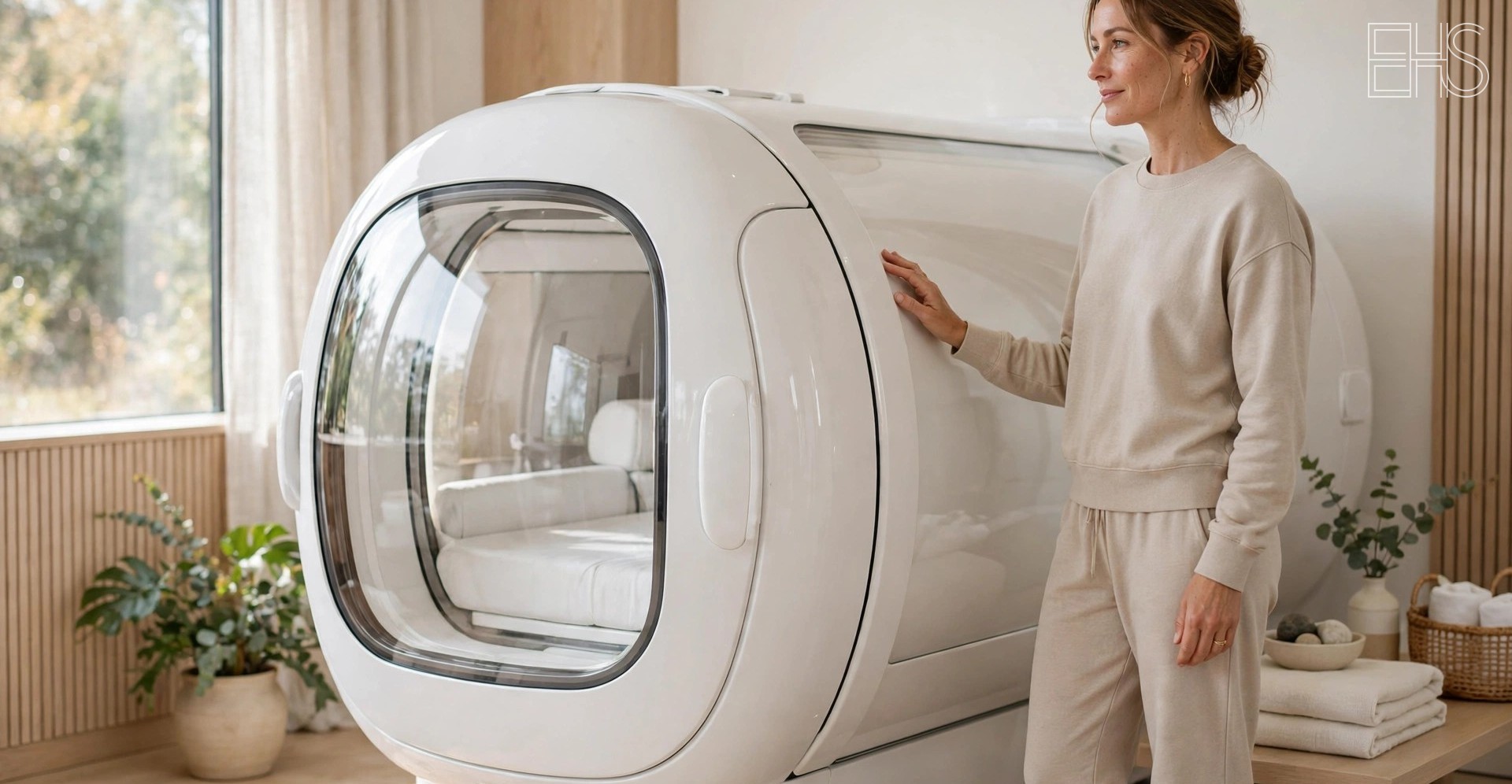
Soft chambers are flexible: a long, reinforced nylon or TPU tube you zip yourself into, roughly the size of a sleeping bag. A small compressor pressurizes it to around 1.3 ATA, versus 1.0 ATA at sea level, and oxygen is typically delivered through a mask or nasal cannula inside.
- Typical price: about $4,500 to $24,400 new, with a median near $13,500 in a July 2026 survey. Verify current rates before buying.
- Pressure: about 1.3 ATA (mild)
- Footprint: Rolls up or folds for storage; needs about 7 to 8 feet of floor during use
- Operation: Consumer-grade; designed for self-administration after training
The format has widened: sit-up vertical and walk-in models now sit alongside the lie-down tube, with October 2026 listings near $10,900 and near $15,100.
Hard chambers
Hard chambers are rigid steel or acrylic vessels, the kind you picture in a hospital. They operate at higher pressures (typically 1.5 to 3.0 ATA) and need professional installation and trained operation.
- Typical price: about $27,500 to $136,100 for personal hard-shell models, median near $41,700 in the same July 2026 survey
- Pressure: 1.5 to 3.0 ATA
- Footprint: Permanent installation, room-sized
- Operation: Requires trained staff; not a realistic consumer purchase
For home buyers, hard chambers are essentially out of scope.
The 2026 Market: What You Can Actually Buy
The table below lists the soft chambers most often sold for home use, with prices as listed in October and November 2026. Verify current rates.
| Model | Listed price (late 2026) | Max pressure | What to know |
|---|---|---|---|
| Newtowne A4-34 | about $5,795 | 1.3 ATA | FDA-cleared; lowest-priced cleared soft chamber |
| Summit to Sea Grand Dive | about $13,495 to $13,995 | 1.3 ATA | FDA-cleared; roomiest at 40 inches wide |
| OxyHealth Vitaeris 320 | about $15,000 to $23,000 | 1.3 ATA | FDA-cleared; five-year warranty |
Three brands hold FDA 510(k) clearance for soft chambers at 1.3 ATA: OxyHealth, Summit to Sea, and Newtowne Hyperbarics. The clearance covers one use only, acute mountain sickness. Every wellness use sits outside it.
Renting is the middle path most buyers skip: home chamber rentals typically run $500 to $1,500 a month, and a few months of rental answers the only question that matters: whether you enjoy lying still in a pressurized tube for an hour.
The Evidence Question: Read This Carefully
The evidence for high-pressure clinical hyperbaric therapy for its approved clinical uses is strong. The evidence for mild-pressure soft chambers used for general wellness is a different story:
- Studies are few, small, and often short-term, and many positive findings come from manufacturer- or clinic-funded studies.
- The proposed mechanisms are plausible (more oxygen delivery under mild pressure), but plausible is not proven.
- There is no credible evidence that mild hyperbaric sessions prevent, treat, or cure any disease, and any company claiming otherwise is one to avoid.
Some users report feeling more rested or recovering faster, but those reports are subjective: the placebo effect, the forced rest of lying still for an hour, and the ritual itself all plausibly contribute.
What the last year added
A 2026 systematic review (Mohammadi and colleagues) of seven studies with 502 adults aged 51 to 85 found better attention, executive function, and processing speed at 2.0 to 2.2 ATA, but that is clinical pressure, not what a soft home chamber delivers.
Smaller mild-pressure studies also appeared: a 2026 trial at high altitude (Lin and colleagues) found better sleep and working-memory accuracy in healthy young adults, and a 2026 study of 12 male athletes (Qu and colleagues) found better subjective sleep and higher power output 24 hours later. Both are small, and the athlete study enrolled men only.
The soreness question remains unsettled: a 2005 Cochrane pooled analysis of 219 people found muscle soreness worse, not better, when hyperbaric oxygen started right after exercise, while a 2026 pooled analysis of ten trials found faster recovery without reporting whether its trials used a sham control. A December 2025 review of 18 studies (671 people) found consistent pain reductions in fibromyalgia and after knee surgery, but inconsistent results for muscle soreness. The Undersea and Hyperbaric Medical Society does not endorse in-home hyperbaric therapy under any circumstances.
No published study has tested a home chamber itself. Every trial above used a clinic chamber or a laboratory setup, and most used pressures or oxygen levels a soft home chamber cannot reach. That is the gap to keep in mind when a seller cites a study. The pattern is familiar from other recovery modalities.
Our position: a soft chamber is an expensive way to lie still and breathe.
Realistic Costs of Ownership
The table below lays out the full cost of owning a soft chamber, beyond the sticker price. Figures are typical ranges; verify current rates before buying.
| Cost | Soft chamber | Notes |
|---|---|---|
| Purchase | about $4,500 to $24,400 | Median near $13,500 |
| Oxygen concentrator | Often included; about $800 to $2,500 separate | Needed for oxygen-enriched breathing |
| Maintenance | $200 to $800/year | Zippers, seals, filters, compressor service |
| Space | A room | Needs about 8 feet of clear floor during use |
Also factor in the time cost: sessions typically run 60 to 90 minutes, several times a week.
What to Know Before Buying
1. Pressure is not for everyone
Pressurized environments are genuinely unsuitable for some people, including those with certain lung conditions, ear and sinus issues, and recent surgeries. Anyone with a health condition or taking medication should consider speaking with a qualified professional who knows their history first.
2. Understand what "mild" means
At 1.3 ATA, a soft chamber delivers a fraction of the pressure used in clinical settings. That is by design: it is what makes home use feasible. But clinical evidence for high-pressure therapy does not transfer.
3. Try before you buy
Sessions at wellness clinics typically cost $75 to $200, with premium city clinics listing $300 to $350. Ten sessions costs less than a tenth of a chamber, and tells you whether you enjoy spending 90 minutes zipped in a tube: many people find the confinement unpleasant, and discovering that after a $15,000 purchase is painful.
4. Check the safety basics
Reputable manufacturers publish pressure ratings and emergency depressurization procedures. Look for redundant pressure-relief valves, clear emergency-exit instructions operable from inside, and no-flame-risk materials guidance: oxygen-enriched environments and ignition sources do not mix, so no phones charging inside.
5. Consider the alternatives honestly
An hour of quiet rest, good sleep, and sensible training load management deliver most of what people seek from recovery modalities: at zero cost. A chamber does not replace any of that. Lower-commitment options, such as contrast therapy protocols or a cold plunge safety-first routine, cost far less.
Who This Is Actually For
- High-net-worth wellness enthusiasts who have already optimized sleep, training, and nutrition and want to experiment at the margin.
- Clinic and studio owners adding a modality for clients, where the chamber is a business asset with revenue attached.
- Curious experimenters who should rent sessions, not buy chambers: a red light therapy home guide is a smaller first step.
Who Should Skip It
- Anyone stretching financially to afford it. The evidence does not justify hardship spending.
- Anyone with a health condition that makes pressure exposure unsuitable.
- Anyone claustrophobic. A zipped tube at pressure is not the place to discover this.
- Anyone expecting clinical outcomes. The evidence for wellness use is suggestive at best.
Explore Other Wellness Tools
If a chamber is more commitment than you want, two smaller recovery tools worth a look are NovaaLab's Deep Healing Pad XL (affiliate link), a red-light pad for muscle recovery, and Renu Therapy's Cold Stoic 2.0 (affiliate link), an insulated plunge tub with an integrated chiller.
Frequently Asked Questions
How does a home hyperbaric chamber differ from a hospital one?
Pressure and purpose. Hospital chambers reach 2 to 3 times atmospheric pressure and are used for specific approved clinical treatments. Home soft chambers reach about 1.3 ATA and are marketed for general wellness. The clinical evidence does not transfer, and only three soft-chamber brands hold FDA clearance, for acute mountain sickness only.
How long is a session, and how often do people go?
Typical soft-chamber sessions run 60 to 90 minutes, and regular users often aim for 3 to 5 sessions per week. Factor that into the true cost. Before buying, try a package of sessions at a local facility to confirm you tolerate the enclosure and the time demand.
Is it safe?
For healthy adults using reputable equipment as directed, mild hyperbaric sessions are generally considered low-risk. But "low-risk" is not "no-risk." Pressure affects ears and sinuses, oxygen-enriched environments carry fire-safety implications, and certain health conditions are genuine reasons to sit out. If you have a health condition, consider speaking with a qualified professional before trying a session.
Can children or older adults use one?
Age alone is not the deciding factor; individual health status is. Sessions for a child or an older adult with health conditions should only follow a conversation with a qualified professional who knows their history. When in doubt, the conservative choice is the correct one.
Do I need a prescription to buy a home chamber?
In most jurisdictions, mild soft-shell chambers are sold as consumer wellness devices without a prescription. Higher-pressure units may face medical-device regulation depending on the country, so check your local regulations: they vary, and sellers do not always volunteer the details.
What's the resale market like?
Thin. Hyperbaric chambers are niche, heavy, and hygiene-sensitive, all of which depress resale value. Used units surface sporadically, but there is no deep liquid market. A July 2026 survey put used soft chambers at roughly 40 to 60 percent of new prices. If resale worries hold you back, a lower-commitment tool such as NovaaLab's Deep Healing Pad XL (affiliate link) is a smaller first step.