
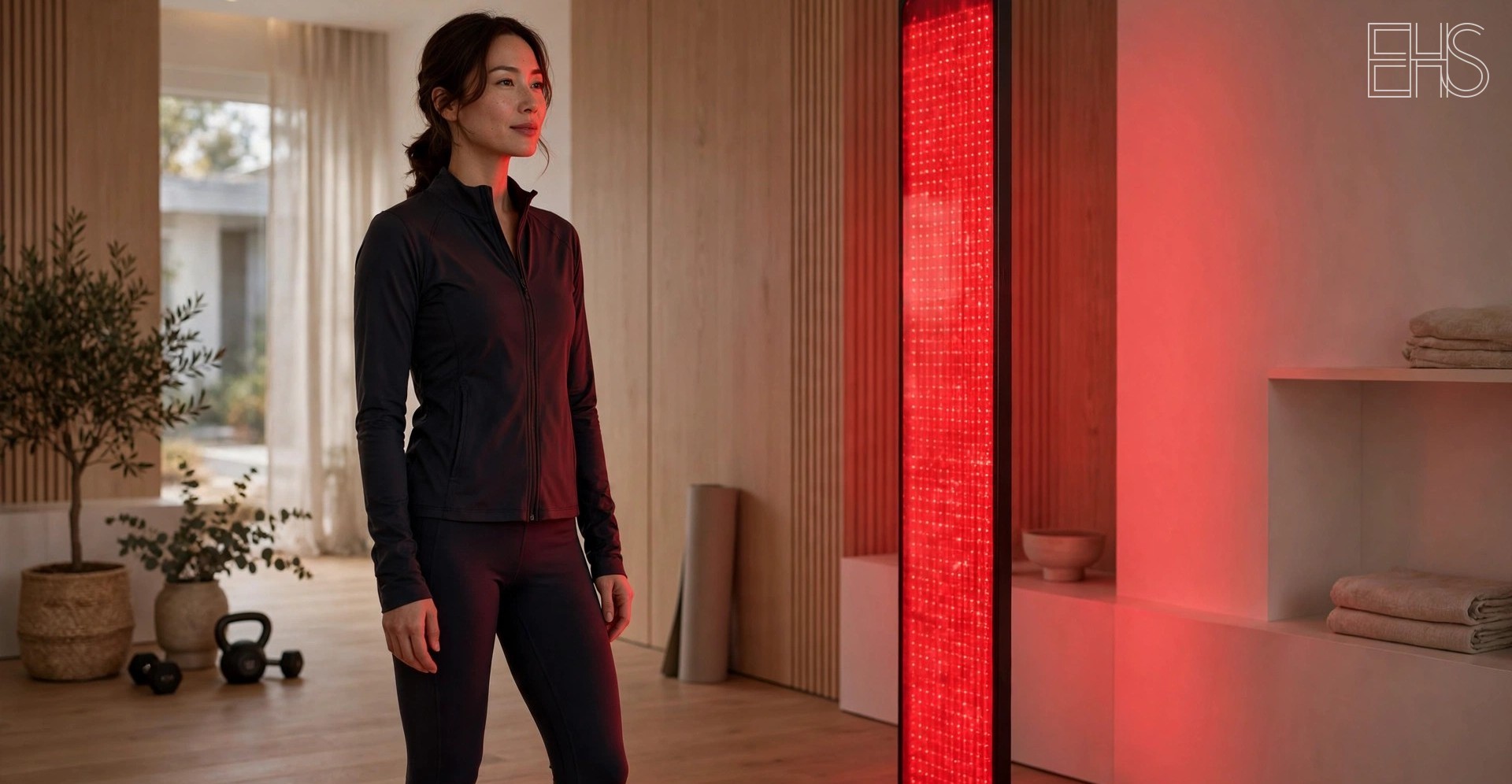
Red light therapy has gone from clinical curiosity to home wellness staple. Devices now range from about $100 to more than $11,000, and the marketing runs well ahead of the evidence. This guide is the corrective: what the devices are, what to compare, what results are realistic, and the safety boundaries. Prices are November 2026 listings; verify current rates before buying.
Key takeaways - Buy on published wavelengths and irradiance with its distance, not headline power figures. - Evidence is modest and narrow: skin and joint findings have support; the rest mostly do not. - Judge a device after 3 to 5 sessions a week for 8 to 12 weeks.
What Red Light Therapy Is
Red light therapy (also called low-level light therapy or photobiomodulation) exposes skin to specific wavelengths of red and near-infrared light from LED arrays:
- Red light, roughly 630–660nm: visible red light, absorbed near the skin surface. Most associated with cosmetic applications.
- Near-infrared, roughly 810–850nm: invisible to the eye, penetrates deeper into tissue. Most associated with muscle and joint claims.
The proposed mechanism: light-absorbing molecules in cells respond to these wavelengths in ways that may influence cellular energy processes. Plausible, with some laboratory support, but the jump to marketing's dramatic outcomes is where things get speculative.
It is not UV tanning, not a laser, and not an infrared sauna, which heats you.
Form Factors: From Wands to Beds
Handheld wands and spot devices ($80–$300): small, targeted, slow: fine for a single knee or a patch of skin, impractical for anything larger.
Masks ($150–$500): face-shaped LED arrays for cosmetic use; a 2026 review found output varied widely.
Joint wraps ($250–$400): flexible wraps for a knee, elbow, or ankle, worn against the joint for 20 minutes.
Small panels ($200–$600): roughly a foot square, covering a face, a joint, or half a torso.
Half-body panels ($500–$1,500): two to three feet tall, covering a torso or full leg. The sweet spot for most home users.
Full-body panels ($1,500–$11,000+): four to six feet tall, whole body in 10–20 minutes. The premium option.
Beds and pods ($20,000+): commercial-grade lie-down units. Foldable blankets are a newer, cheaper take; see below.
Bigger is not automatically better: a smaller panel used diligently beats a large panel gathering dust.
What to Look For When Shopping
Marketing specs are a minefield. What actually matters, in order:
1. Published, specific wavelengths. Reputable manufacturers state exact wavelengths (e.g., 660nm red, 850nm near-infrared). Vague claims like "proven wavelengths" without numbers are a red flag.
2. Irradiance at a stated distance. Irradiance (light power per area, in mW/cm²) determines dose, but the number is meaningless without the distance it was measured at.
3. Coverage area versus your goal. Match the device size to the area you actually use. A handheld wand for full-body ambitions means 45-minute sessions abandoned in a month.
4. Build quality and cooling. Higher-powered panels generate heat and need fans or heat sinks. Check for solid construction and a real warranty (1–3 years is standard).
5. Eye protection included. Any device powerful enough to matter warrants eye protection; goggles in the box is a good sign.
6. Skepticism toward extras. Pulsing modes, app connectivity, and proprietary "protocols" are differentiation theater. Do not pay a premium for them.
A Worked Example: One Brand Measured Against the Checklist
Disclosure: the product links in this section are affiliate links. If you buy through one, EverHealthSpan may earn a commission at no extra cost to you.
The checklist is only useful if a real brand can be measured against it. NovaaLab publishes the specifics this guide asks for.
What checks out. Their devices use 660nm red and 850nm near-infrared LEDs, the two most studied bands. They publish irradiance at stated distances. The devices are FDA-cleared as Class II devices, carry a 60-day money-back guarantee with a 1-year warranty extendable to 3 years, and ship to the US and Canada.
What does not transfer. NovaaLab's product pages also carry customer-survey percentages and week-by-week improvement timelines. A customer survey is not a clinical trial: expect the modest, slow effects documented below, not the marketing timeline. FDA clearance is a manufacturing and safety standard, not proof that any specific outcome will happen for you.
The current lineup, with November 2026 list prices and sale prices seen that month.
| Device | List price (Nov 2026) | What it is |
|---|---|---|
| Novaa Knee Ultra | $269.90 (seen at $229.42 on sale) | Knee wrap, 96 LEDs |
| Light Pad | $349.90 | Strapable pad, 150 LEDs |
| Back Pad | $369 | Back pad, 80 LEDs, vibration |
| Light Boot | $369 | Foot wearable, 170 LEDs |
| Deep Healing Pad XL | $599.90 (seen at $509.92 on sale) | Largest pad, 1,200 chips |
| Recovery Pod | $2,500 (seen at $2,125 on sale) | Full-body blanket, 2,320 LEDs |
Recovery Pod (see the Recovery Pod (affiliate link)), listed at $2,500. A foldable full-body blanket with 2,320 LEDs (6,960 chips) at 660nm and 850nm, for 20-minute sessions, with published irradiance of 120 mW/cm2 at contact, 45 at one inch, and 25 at three inches. The premium-pricing skepticism applies: you pay to cover the whole body at once.
Deep Healing Pad XL (see the Deep Healing Pad XL (affiliate link)), listed at $599.90. A flexible pad, 1,200 light chips in 400 tri-chip LEDs, covering a whole back, both knees, or hips and shoulders in one session.
The clearest transparency example is the standard Light Pad: NovaaLab publishes a full distance curve for it, 150 mW/cm2 at contact, 120 at one inch, 45 at three inches, 25 at six inches.
Prices are the brand's listed prices seen in November 2026; verify current rates before buying. The 60-day return window is the practical test of whether you use it 3 to 5 times a week.
Realistic Expectations
The honest evidence picture, most to least supported; our red light therapy evidence review grades each claim in full.
Skin appearance (fine lines, wrinkles): The best-supported cosmetic use. Several randomized trials show modest improvements in wrinkle depth and skin texture with consistent use over 8–12 weeks. "Modest" is doing real work in that sentence.
Wound and skin recovery: Some clinical support, mostly in professional settings. Home devices are weaker than clinical ones.
Muscle soreness and perceived recovery: Mixed. Some small trials show reduced perceived soreness; effects on measured performance are inconsistent.
Joint and muscle pain: Mixed to thin. Some positive small trials, plenty of inconclusive ones.
Sleep, fat loss, testosterone, cognition, hair regrowth: Thin to speculative for home devices. These are the claims that sell panels, with the weakest support.
What the last year added: A 21-expert consensus in the Journal of the American Academy of Dermatology (2025) called photobiomodulation safe for adults and supported its use for skin rejuvenation. A 2025 umbrella review of 15 meta-analyses (204 trials, 9,000-plus people) found moderate-certainty benefit for a handful of outcomes, including knee osteoarthritis disability. Neither changes the verdicts above: the support stays narrow and modest.
The pattern across all of it: effects, where they exist, are modest, need weeks of consistent use (3–5 sessions a week, 10–20 minutes each), and come from devices used at proper distance and duration.
Safety and Who Should Be Careful
Red light therapy has a reassuring safety profile in the studied uses: non-invasive, non-thermal at normal doses, and no UV skin damage. But "generally safe" is not "safe for everyone":
Eyes: Do not stare into the LEDs. Near-infrared is invisible: there is no blink reflex for light that cannot be seen. Wear the provided eye protection, or keep eyes closed.
Photosensitizing medications: Certain antibiotics, retinoids, and other drugs increase light sensitivity. If you take prescription medication, check its leaflet for light-sensitivity warnings before starting.
Pregnancy: Insufficient data, so the cautious choice is to skip it.
Active skin cancer or suspicious lesions: Do not shine bright light on anything undiagnosed. Have any skin concern looked at first.
Overuse: More is not better. Excessive sessions or very close-range use can cause temporary skin redness or irritation. Follow the manufacturer's distance and duration guidance.
None of this is meant to alarm: for healthy adults using a quality device sensibly, the risk profile is low.
Cost Tiers and the Value Question
The table maps the price bands above to what each tier buys.
| Tier | Price range | What you get |
|---|---|---|
| Handheld / spot | $80–$300 | Targeted small areas only |
| Masks | $150–$500 | Face-only cosmetic use |
| Joint wraps | $250–$400 | One joint at a time |
| Small panels | $200–$600 | One body region |
| Half-body panels | $500–$1,500 | Torso or full leg |
| Full-body panels | $1,500–$11,000+ | Whole body |
The value question is really a consistency question. A $400 panel used 4 times a week for a year costs about $2 per session; a $3,000 panel used twice and shelved costs $1,500 per session and produces nothing. Buy the device you actually use regularly.
How People Actually Use Them
The effective pattern, distilled from both studies and long-term users: 3–5 sessions per week, 10–20 minutes per area, at the manufacturer-recommended distance, for at least 8–12 weeks before judging results. Consistency matters more than device tier. Schedule sessions like workouts, treat one goal at a time, and log the first two months so you judge actual change rather than impression.
Panels pair naturally with the heat and cold modalities in our contrast therapy guide. Our infrared sauna buying guide covers the cabins that complement a panel.
Frequently Asked Questions
Does red light therapy actually work?
For narrow uses, modest improvements in skin appearance and perceived recovery, there is genuine if modest evidence from randomized trials. A 2025 umbrella review found moderate-certainty benefit for a handful of outcomes, including knee osteoarthritis disability and hair density. For the broader marketed menu (fat loss, cognition, hormones, systemic anti-aging), the evidence is thin to nonexistent.
How long before I see results?
For cosmetic goals, studies typically ran 8–12 weeks of consistent use (3–5 sessions per week) before measuring results. Anyone promising visible change in days is selling, not informing. For perceived recovery, some users report differences within a couple of weeks, but early impressions are unreliable.
Is it safe for my eyes?
Treat it with respect. Do not stare into the LEDs, wear eye protection (especially with high-irradiance panels), and remember that near-infrared wavelengths are invisible: you cannot rely on discomfort to warn you. With basic precautions, eye risk is minimal.
Is red light therapy the same as an infrared sauna?
No, though the confusion is understandable. Infrared saunas heat your body with radiant warmth: heat, sweat, and elevated heart rate. Red light panels produce very little heat; the proposed mechanism is light interacting with cells. They are different modalities. Our infrared versus traditional sauna comparison covers the sauna side.
Can I overdo it?
Yes. More is not better. Excessive duration or very close-range sessions can cause temporary skin redness and irritation, with no evidence that mega-dosing improves outcomes. Follow the manufacturer's guidance on distance and session length. If your skin stays red or irritated after sessions, increase distance, shorten sessions, or take a break.
Do I need the most expensive panel to get results?
No. The relevant variables are wavelength, irradiance at distance, and consistent use: not price tags. A mid-range device from a transparent manufacturer used diligently will outperform an expensive panel used sporadically. One example of that middle ground is the standard Light Pad (see the Light Pad (affiliate link)), listed at $349.90, with its full distance curve published.